The Omnichord has a devoted following. Its dreamy, harp-like strum defined a corner of 80s pop and still turns up on modern records, and since Suzuki brought it back in 2024, a lot more people want one. Here is what an Omnichord is, what it costs in 2026, where to play one online for free, and the alternatives worth a look if the real thing is out of reach.
The short answer
Suzuki's reissued Omnichord OM-108 is the real thing and costs around $899 new. Vintage models run several hundred dollars used. Cheaper or more portable alternatives include the Minichord (about $175, open source), the HiChord (from about $249), and pocket synths like GLIDE. To just try the sound, free browser Omnichords exist.
- What an Omnichord is
- Buying an Omnichord in 2026
- Omnichord alternatives compared
- Play an Omnichord online for free
- Which one is right for you?
What an Omnichord is
The Omnichord is an electronic instrument made by Suzuki, first released in 1981. You press chord buttons with your left hand and brush your right hand across a touch-sensitive strip called the strumplate (Suzuki calls it Sonic Strings), which plays the notes of that chord like a harp or autoharp. Built-in rhythms and a bass line fill in the rest.
That is the whole appeal: you do not need to know how to play anything. Pick a chord, sweep your hand, and it sounds lovely. Suzuki stopped making the original line in 1996, which is why vintage models became collector items and why the 2024 reissue was such big news.
Buying an Omnichord in 2026
New: Suzuki Omnichord OM-108
Announced at NAMM in January 2024, the OM-108 is the first new Omnichord in almost thirty years. It keeps the chord buttons and strumplate and adds more:
- Up to 108 chords by combining buttons, including sus4 and add9
- Ten voices, including recreations of the classic OM-84 sounds
- Ten rhythms and an OM-84 mode
- MIDI out, a built-in speaker and a headphone jack
It runs on eight AA batteries or a 12V adapter; in the US both are sold separately. Guitar Center lists it at $899 as of September 2026.
Used: vintage OM-27 and OM-84
The OM-27 (1981) and OM-84 (1984) are the classic models collectors look for. They usually sell for several hundred dollars used, more for clean or red units. Before buying, check that the strumplate responds along its whole length and that the battery compartment is free of corrosion, as you would with any vintage electronic instrument.

Omnichord alternatives compared
| Instrument | How you play chords | Price (Sept 2026) | Good for |
|---|---|---|---|
| Suzuki OM-108 | Chord buttons plus strumplate | About $899 | The authentic sound |
| Telepathic Orchid | One-octave keyboard picks the root, buttons set the chord type | $649, sold out (waitlist) | Songwriting, rich voicings |
| HiChord | Seven chord buttons plus a joystick for chord color | From about $249 | Pocket chord machine with looper |
| Minichord | 21 chord buttons plus a harp touch zone | About $175 | The Omnichord idea, pocket sized and open source |
| GLIDE (ours) | Chord row plus three rows you play melody on, scale locked | $119.99 | Playing along with songs, sliding leads |

Telepathic Instruments Orchid
Chord synthCo-founded by Kevin Parker of Tame Impala, the Orchid lets you pick a root on a small keyboard and a chord type with buttons, with dials for inversions and strum, arpeggio and harp modes. It is a serious songwriting tool with a looper and drum beats. It is currently sold out, with a waitlist.
HiChord
Pocket chord synthThe HiChord fits in a pocket: seven chord buttons, a joystick that changes chord quality, 30+ instruments, a six-track looper and a drum machine. Aluminum editions are on pre-order at $320; a plastic standard edition has sold for about $249.
Minichord
Open sourceThe Minichord is the closest thing to a pocket Omnichord: 21 chord buttons and a harp zone you strum with a finger, USB MIDI, and about eight hours per charge. Its hardware and code are open source, so tinkerers can make it their own.
GLIDE
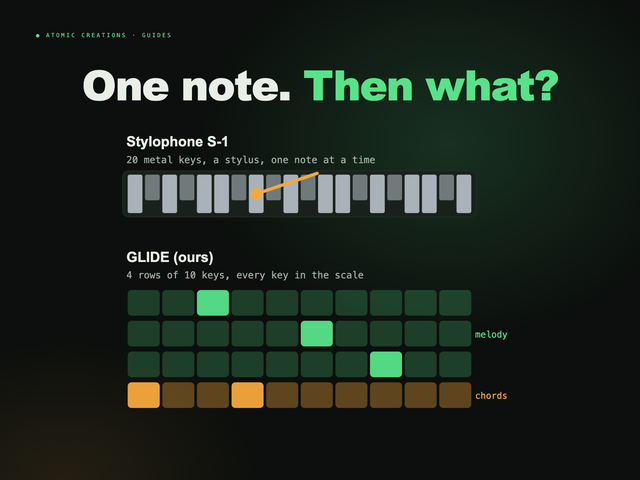
Pocket synthFull disclosure: this one is ours, and it is not an Omnichord. There is no strumplate. What it shares is the promise that you cannot play a wrong note. The bottom row of GLIDE plays chords in the current key, and the three rows above are tuned like strings, so notes slide into each other while you play a melody over the chords. It can also listen to a song through its microphone and retune itself to that song's key. You can play it in your browser at the bottom of this page.
Where is the Stylophone? It is a lovely, cheap pocket instrument, but you play it one note at a time with a stylus, so it does not do the Omnichord's chord-and-strum trick.
Play an Omnichord online for free
Want the sound before spending anything? Several browser versions let you click chords and strum with your mouse or keyboard:
- Omnichord Online recreates the OM-27 layout with 27 chord buttons, a strumplate and rhythms. The basics are free; recording and extra songs are paid.
- omnichord.amplib.app is a web Omnichord with chord, harp and drum voices and presets.
- nicorobo/Omnichord is an open-source version on GitHub if you want to see how one works.
None of these is made by Suzuki, but they are a great way to find out whether the chord-and-strum style clicks for you.
Which one is right for you?
Get the real Omnichord if
- You want that exact strumplate sound
- It will live on a desk or a stage
- You want MIDI out to a computer
- The budget stretches to around $900
Go smaller if
- You want it in a bag or pocket
- Budget matters (Minichord, GLIDE)
- You want to tinker (Minichord)
- You want to play along with songs (GLIDE)
Whichever way you go, the best thing about this whole family of instruments is the same: they skip the years of practice and let you make something beautiful on day one. Curious how the chords fit together? Our circle of fifths guide shows which chords belong in every key.
Useful? Pass it on
← Browse all guides