Almost everything in Western music is measured against the major scale. Chords, keys, other scales, even the "do re mi" you learned as a kid all come from it. The good news: it is built from one simple pattern, and once you know the pattern you can play it starting on any note.
The short answer
A major scale is seven notes built with the step pattern whole, whole, half, whole, whole, whole, half (W W H W W W H). On a keyboard, a half step is the very next key and a whole step skips one. Start on C and the pattern gives you all the white keys: C D E F G A B C.
- The major scale formula
- How to build it on any note
- All 12 major scales
- Scale degrees and do re mi
- Playing it on piano
- Why it matters
The major scale formula
Music moves in steps. A half step is the smallest distance on a keyboard or guitar: one key to the very next key, black or white, or one fret. A whole step is two half steps.
Every major scale, in every key, follows the same pattern of steps between its notes:
Written as numbers of half steps, it is 2 2 1 2 2 2 1. That pattern is the major scale. Its bright, settled sound comes from where those two half steps sit.
How to build it on any note
- Pick a starting note. Say G.
- Walk the pattern. From G, a whole step is A, another whole step is B, a half step is C, then whole steps to D, E and F♯, and a half step back to G.
- Use each letter once. A major scale uses every letter name A to G exactly once, which is why the seventh note of G major is written F♯, not G♭.
That is all there is to it. The sharps and flats a key needs are just whatever the pattern forces on you. G major needs one sharp; D major needs two. The circle of fifths shows how that count grows key by key.
All 12 major scales
| Key | 1 | 2 | 3 | 4 | 5 | 6 | 7 |
|---|---|---|---|---|---|---|---|
| C | C | D | E | F | G | A | B |
| G | G | A | B | C | D | E | F♯ |
| D | D | E | F♯ | G | A | B | C♯ |
| A | A | B | C♯ | D | E | F♯ | G♯ |
| E | E | F♯ | G♯ | A | B | C♯ | D♯ |
| B | B | C♯ | D♯ | E | F♯ | G♯ | A♯ |
| F♯ | F♯ | G♯ | A♯ | B | C♯ | D♯ | E♯ |
| D♭ | D♭ | E♭ | F | G♭ | A♭ | B♭ | C |
| A♭ | A♭ | B♭ | C | D♭ | E♭ | F | G |
| E♭ | E♭ | F | G | A♭ | B♭ | C | D |
| B♭ | B♭ | C | D | E♭ | F | G | A |
| F | F | G | A | B♭ | C | D | E |
E♯ in F♯ major is the same key as F on a piano. It is written E♯ so every letter appears once.
Scale degrees and do re mi
Each note of the scale has a number and a name, and they work the same in every key:
| Degree | Name | Solfège | In C |
|---|---|---|---|
| 1 | Tonic (home) | do | C |
| 2 | Supertonic | re | D |
| 3 | Mediant | mi | E |
| 4 | Subdominant | fa | F |
| 5 | Dominant | sol | G |
| 6 | Submediant | la | A |
| 7 | Leading tone | ti | B |
Numbers are how musicians talk across keys. "Go to the 4" means F in C major and C in G major. It is also where chord names like I, IV and V come from, which is the heart of every common chord progression.
Playing it on piano
The standard fingering for C major, one octave, numbering fingers thumb = 1 to pinky = 5:
- Right hand, going up: 1 2 3, tuck the thumb under, 1 2 3 4 5.
- Left hand, going up: 5 4 3 2 1, cross finger 3 over, 3 2 1.
Go slowly and evenly, then reverse. Once C feels easy, try G and F: they change just one note each (F♯ in G, B♭ in F).
Why it matters
- Keys come from it. "A song in D major" means a song built mostly from the D major scale.
- Chords come from it. Stack every other note of the scale and you get the seven chords of the key.
- Other scales are measured against it. The natural minor scale is the major scale starting on its 6th note (that is the relative minor). The pentatonic scale is the major scale with two notes removed.
Play any scale without learning the fingering
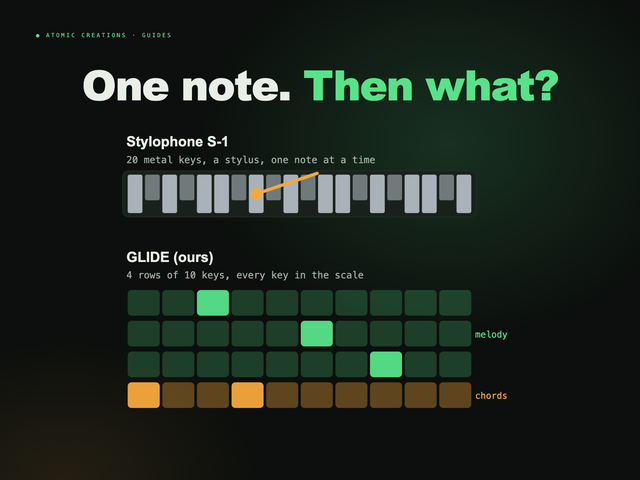
GLIDE, the pocket synth we make, has scale lock: every key plays a note from the scale you choose, so you can hear and play a major scale in any key instantly. Press fn and S to walk through the scales (major, the pentatonics, the modes, blues and more), or let Auto Key hear a song and pick the key for you. The browser version below starts in A minor pentatonic; flip scale lock off to hear all twelve notes.
Useful? Pass it on
← Browse all guides