If there is one scale worth learning first, it is the pentatonic. It has only five notes, it works over a huge amount of music, and it has a party trick: it is very hard to play a note that sounds wrong. That is why it is behind countless guitar solos, folk melodies and pop hooks.
The short answer
A pentatonic scale is a five-note scale. The major pentatonic is the major scale without its 4th and 7th notes (C D E G A). The minor pentatonic uses the same five notes starting from the relative minor (A C D E G). Leaving out those two notes removes the half steps that cause clashes, which is why almost anything you play from it sounds good.
- What makes it pentatonic
- Why you can't play a wrong note
- Pentatonic scale on piano
- Pentatonic scale on guitar
- Pentatonic scales in common keys
- Add one note: the blues scale
- How to use it
What makes it pentatonic
"Penta" means five. A pentatonic scale has five notes per octave instead of the seven in a major scale. The two most useful versions:
- Major pentatonic: degrees 1, 2, 3, 5, 6 of the major scale. In C: C D E G A. Bright, open, a little country or folk.
- Minor pentatonic: degrees 1, ♭3, 4, 5, ♭7. In A: A C D E G. Bluesy, rock, soulful.
Notice those are the same five notes. A minor pentatonic is C major pentatonic starting from A, the same way A minor is the relative minor of C major.
Why you can't play a wrong note
In a major scale there are two half steps, the tightest intervals, between the 3rd and 4th notes and between the 7th and the octave. Those half-step notes are the ones most likely to rub against the chord underneath. The pentatonic simply leaves the 4th and 7th out.
What remains are notes spaced a whole step or more apart, and none of them clash hard with the main chords of the key. So you can press almost any combination, in almost any order, and it sounds like music. Beginners sound good immediately, and experts use it because it never gets in the way.
Pentatonic scale on piano
Here is the famous shortcut: the black keys are a pentatonic scale. Play only black keys, in any order, and it will sound good. Technically that is G♭ major pentatonic, or E♭ minor pentatonic if you treat E♭ as home.
Pentatonic scale on guitar
This box is one of the most-used shapes in guitar music: two notes per string, all within four frets. Slide the whole shape to start on a different fret on the low E string and it becomes the minor pentatonic of that note: 3rd fret for G, 8th fret for C, 12th fret for E.
The same shape is also C major pentatonic. Treat the C notes as home instead of the A notes and it sounds major.
Pentatonic scales in common keys
| Minor pentatonic | Notes | Major pentatonic | Notes |
|---|---|---|---|
| A minor | A C D E G | C major | C D E G A |
| E minor | E G A B D | G major | G A B D E |
| B minor | B D E F♯ A | D major | D E F♯ A B |
| F♯ minor | F♯ A B C♯ E | A major | A B C♯ E F♯ |
| D minor | D F G A C | F major | F G A C D |
| G minor | G B♭ C D F | B♭ major | B♭ C D F G |
| C minor | C E♭ F G B♭ | E♭ major | E♭ F G B♭ C |
Each row pairs a minor pentatonic with its relative major pentatonic: same notes, different home.
Add one note: the blues scale
Add the ♭5 to the minor pentatonic and you get the blues scale: in A, that is A C D E♭ E G. That extra note is deliberately tense. Slide through it on the way to E rather than landing on it, and you instantly sound like the blues.
How to use it
- Soloing: over a song in A minor (or C major), noodle on A minor pentatonic. End phrases on A for a settled sound.
- Writing melodies: hum over your chords, then find those notes in the pentatonic. Many singable melodies live there.
- Finding the key first: the scale only works if it matches the song. Our guide to finding the key of a song shows how.
An instrument built on it
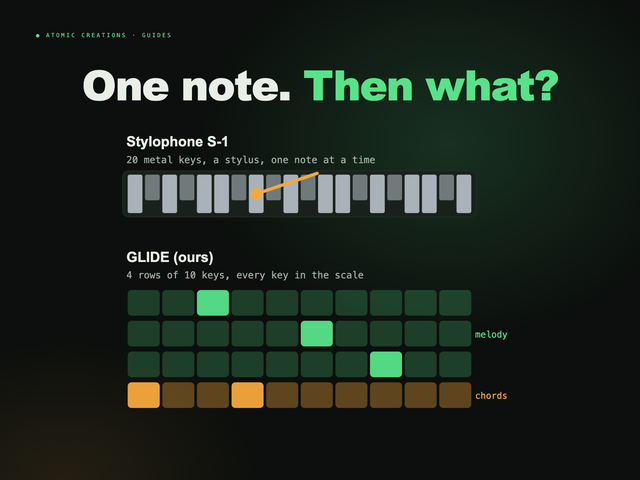
GLIDE, the pocket synth we make, starts in A minor pentatonic out of the box. Every key on its keyboard is a note from the scale, so there are no wrong keys at all, and notes slide into each other like a fretless string instrument. When a song is playing, Auto Key hears it and retunes the keys to the song's key. The version below runs in your browser: press anything, then flip scale lock off to hear how much harder a regular keyboard is.
Useful? Pass it on
← Browse all guides