Lofi is the sound of a rainy window at 2 a.m.: a dusty piano loop, a lazy drum beat that never quite sits on the grid, and a soft bed of vinyl crackle underneath. It soundtracks millions of study sessions and late-night coding marathons, and the best part is that it is one of the friendliest styles to make yourself. Here is what lofi means, where it came from, what makes the sound, and a step-by-step recipe for your first lofi beat, using free tools.
The short answer
Lofi is short for low fidelity: music where hiss, crackle and a muffled tone are left in on purpose. Today it mostly means lofi hip hop, the mellow, jazzy instrumental beats behind streams like Lofi Girl. To make one: set a tempo around 70 to 90 BPM, loop four seventh chords on a soft keys sound, add swung drums, then roll off the highs with a low-pass filter and lay vinyl crackle and tape wobble on top. BandLab and GarageBand are free and do all of it.
- What does lofi mean?
- Where lofi hip hop came from
- What makes the lofi sound
- Lofi chords and progressions
- How to make lofi beats, step by step
- How to make lofi for free: BandLab, GarageBand, FL Studio
- Full disclosure: this one is ours
- Lofi FAQ
What does lofi mean?
Lofi (also written lo-fi or low-fi) stands for low fidelity, the opposite of hi-fi. Originally it described any recording made on cheap gear, where tape hiss, room noise and a slightly muffled sound were part of the deal. Over time, those "flaws" became a style that people chose deliberately, because they make music feel warm, human and close, like a record playing in the next room.
When most people search "lofi" today, they mean lofi hip hop (sometimes called chillhop): slow, instrumental beats built from jazzy chords, soft drums and a layer of dust. It is music designed to sit in the background while you study, work, draw or game, which is exactly why it became the internet's favorite focus soundtrack.
Where lofi hip hop came from
Lofi hip hop grew out of the instrumental hip hop and beatmaking scene of the late 1990s and 2000s. A few names come up again and again:
- J Dilla. The Detroit producer famously turned off the quantize setting on his drum machine, so his drums landed loose and slightly off the grid. That laid-back, "drunk" feel is the rhythmic DNA of lofi. His album Donuts came out on February 7, 2006, his 32nd birthday, and he died three days later.
- Nujabes. The Tokyo producer Jun Seba made warm, jazz-sampling beats and was one of the main contributors to the soundtrack of the 2004 anime Samurai Champloo, including its opening theme "Battlecry" with Shing02. He died in 2010 at 36, and he is often called the godfather of lofi hip hop. That anime connection is part of why lofi still looks the way it does.
- Madlib and the sampler crowd. Madvillainy, the 2004 album by MF DOOM and Madlib, is widely treated as a touchstone. Underground producers in the 2000s and 2010s traded dusty beats made on samplers like the Roland SP-404, which, as one of the founders of the cassette label El Sereno Records told Bandcamp Daily, even had a "lo-fi" button that people joked about.
Then YouTube turned it into a phenomenon. In the late 2010s, 24/7 livestreams of lofi beats with an anime-style loop became a fixture, and one channel became the face of the genre. It started in 2015 as ChilledCow, and its looping animation of a girl studying by a window, drawn by Colombian illustrator Juan Pablo Machado in a Studio Ghibli-inspired style, became so iconic that the channel renamed itself Lofi Girl in March 2021. Its "beats to relax/study to" stream became a meme, a study ritual and a genre label all at once. When a false copyright claim knocked the stream offline in July 2022, it made national news; NPR's report covers how it came back two days later.
| Year | Milestone |
|---|---|
| 2003 | Nujabes releases his debut album Metaphorical Music |
| 2004 | Samurai Champloo airs with Nujabes on the soundtrack; MF DOOM and Madlib release Madvillainy |
| 2006 | J Dilla releases Donuts |
| 2015 | The ChilledCow YouTube channel launches |
| 2021 | ChilledCow renames itself Lofi Girl |
| 2022 | A false copyright claim takes the Lofi Girl stream down for two days |
What makes the lofi sound
Nearly every lofi beat is built from the same handful of ingredients. Once you can hear them, you can make them.
- Slow tempo. Most lofi sits somewhere around 70 to 90 BPM. Slow enough to relax to, fast enough that the drums still nod.
- Jazzy chords. Seventh and ninth chords instead of plain triads, usually on a mellow electric piano, a felt piano, a guitar or a soft pad. More on these below.
- Swung, loose drums. A soft kick, a snare or rimshot on 2 and 4, and hi-hats with swing so every second hat lands a little late. The J Dilla effect: played, not programmed.
- A muffled top end. A low-pass filter rolls off the high frequencies, so everything sounds warm and slightly far away.
- Tape wobble. A slow, tiny wander in pitch, like a cassette that has been played a few hundred times.
- Texture. Vinyl crackle, tape hiss, rain, a café murmur. Quiet, but always there.
- Space. Short loops with room to breathe. Lofi is music for the background, so it rarely gets busy.
Lofi chords and progressions
The jazzy color in lofi comes from extended chords. A normal chord (a triad) stacks three notes, each a third apart. Keep stacking thirds and you get a seventh chord (four notes), then a ninth chord (five notes). Each extra note softens the chord and adds that wistful, unresolved feeling.
Two progressions you will hear everywhere in lofi, shown in C major so you can play them on the white keys:
- The jazz loop (ii7, V7, Imaj7, vi7). The ii-V-I is the backbone of jazz harmony, and adding the vi7 lets it cycle forever.
- The slow walk down (IVmaj7, iii7, ii7, Imaj7). Each chord steps down the scale, which gives that gentle, sinking, end-of-the-day mood.
If you know your basic progressions, you can "lofi" any of them by turning every chord into its seventh version. Our guide to the most common chord progressions has plenty to start from. Many lofi tracks also lean toward minor keys and the Dorian mode, which keeps things moody without getting sad.
How to make lofi beats, step by step
The drum programming works like any other hip hop beat, so if you have never made one, start with our guide on how to make a beat. Here is the lofi recipe on top of it:
- Set the tempo. Start at 80 BPM. Go down toward 70 for sleepier tracks, up toward 90 for a bit more bounce.
- Write four seventh chords. Use one of the progressions above on a warm keys sound (electric piano, felt piano or a soft pad), one chord per bar. Let the notes overlap a little so they blur together.
- Lay down soft drums. Kick on 1 and somewhere around the "and" of 3, a snare or rimshot on 2 and 4, hi-hats on eighth notes. Pick quiet, round sounds; nothing should snap.
- Add swing. Turn up your DAW's swing or groove control until the hats shuffle. If your DAW lets you, nudge a few kicks and snares slightly late by hand, too.
- Add a simple bassline. Play the root of each chord, long and round, lined up with the kick. A sine-like bass or a muted electric bass both work.
- Top it with a short melody. Three or four notes, repeated, with lots of space. A guitar, flute, vibraphone or a soft synth lead are all classic. Pentatonic notes are a safe bet.
- Dust it up. Run the whole loop through a low-pass filter, a little saturation and a slow pitch wobble, then add a quiet vinyl crackle or rain sample underneath (see the chain below).
- Arrange. Lofi tracks tend to be short and loop-based. Start with just the chords, bring in the drums, drop them out for a bar or two before the loop comes back, and fade out on the texture.
About samples. Classic lofi is built on chopped jazz and soul records, but a sample from someone else's record belongs to its owners, and releasing it without clearance can get your track pulled. If you plan to upload, play your own chords or use royalty-free sample packs whose license allows it.
How to make lofi for free: BandLab, GarageBand, FL Studio
You do not need to spend anything to make a convincing lofi beat. Three popular starting points:
Free forever
- BandLab: free, runs in a web browser and as an app on iPhone and Android, with built-in instruments, drums and effects. Great for making beats on a phone in bed.
- GarageBand: free on Mac, iPhone and iPad. Its sound library and Drummer track make it easy to get a soft, jazzy groove going. Details on Apple's GarageBand page.
Free to try
- FL Studio: a favorite of hip hop producers. Its trial has no time limit and includes every feature, and you can export finished tracks to WAV or MP3. The catch: it cannot reopen saved projects until you buy a license, so finish a beat in one sitting.
- FL Studio Mobile: a separate app for iPhone and Android if you would rather work on the go.
Whatever you pick, the recipe is the same: chords, swung drums, bass, a little melody, then the low-pass and crackle. Most DAWs include a filter and saturation effect, and free vinyl crackle samples are easy to find. When you are ready to turn a loop into a full song with sections and a hook, our guide to how to write a song picks up from there.
Full disclosure: this one is ours
The hardest part of lofi is not the mixing. It is finding a chord loop and a melody that feel good, and those ideas usually show up when you are on the couch, not at the desk. That is the gap the pocket synth we make was built for.
GLIDE
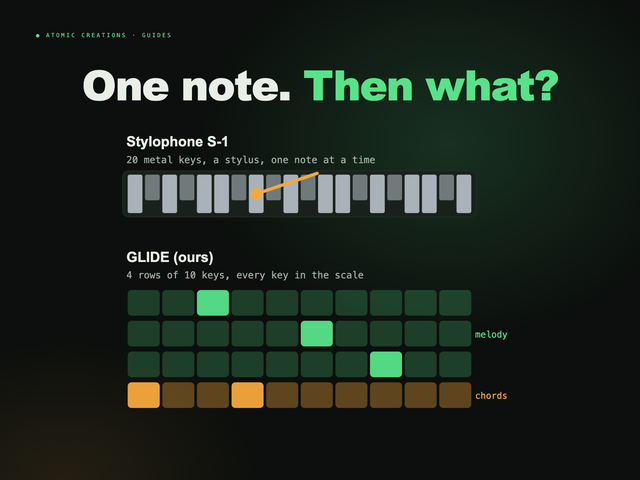
Pocket synthFull disclosure: this one is ours. GLIDE is a pocket synthesizer on the M5Stack Cardputer ADV, built and tested by hand in small batches. Its keyboard plays like four strings, notes slide into each other, and scale lock means every key is in key. It has a speaker for the couch and a 3.5mm output for recording into your DAW.
$119.99 (checked October 2026). The next batch drops soon; join the waitlist and you get the drop email 24 hours before it goes public.
Here is what a lofi session on it looks like:
- Chords with no timing required. Tap four chords on the bottom row and GLIDE loops them as a progression, one per bar, always in key, with the Roman numerals on screen so you learn the theory as you go. Its built-in progressions use triads; for jazzier seventh shapes, finger your own four-note chords across the rows (it plays up to eight voices).
- Swing is a setting. Turn on the arpeggiator and your chords break into notes; set Arp swing to 66% (it calls it "shuffle") and the pattern lands with that lazy, behind-the-beat bounce. Tap your tempo in on the keyboard, and a metronome locks to it.
- Warm and dusty by design. A low-pass filter for a muffled top end, a Drift control that lets each voice wander a few cents in pitch like an old tape machine, plus chorus, reverb and a delay that locks to your tempo. Randomize rolls whole new sounds by character, including tine pianos, pads, drawbar organs and bowed strings. Its default color theme is even called "cassette".
- Play along with the stream. Hold fn+K next to a lofi playlist and GLIDE listens through its mic, works out the song's key, mode and tempo, and retunes itself so you can noodle along. (More on that on our play along with any song page.)
- Keep the take. A one-button looper records your performance so you can stack a melody over your chords, then play it into your computer through the headphone jack.
To be clear about what it is not: GLIDE has no drum machine and no sampler. Drums and the final dusting still happen in your DAW. Think of it as the idea machine that sits next to your laptop, or on your nightstand, and turns "I have a vibe" into a chord loop and a melody before the vibe wears off. You can play a version of it in your browser at the bottom of this page.
Lofi FAQ
What does lofi mean?
Lofi is short for low fidelity: a recording where imperfections like tape hiss, vinyl crackle and a muffled tone are left in, usually on purpose. Today the word mostly refers to lofi hip hop, the relaxed, jazzy instrumental beats people play while studying or working.
What BPM is lofi?
Most lofi sits somewhere around 70 to 90 BPM, often near 80. Swung drums make it feel even more laid back than the number suggests.
Can you make lofi beats for free?
Yes. BandLab is free in a web browser and on phones, GarageBand is free on Mac, iPhone and iPad, and FL Studio has a trial with no time limit that can export finished tracks but cannot reopen saved projects until you buy it.
What chords are used in lofi?
Mostly seventh and ninth chords, which add one or two extra notes to a basic chord for a softer, jazzier color. Two common loops in C major are Dm7, G7, Cmaj7, Am7 and Fmaj7, Em7, Dm7, Cmaj7.
How do you make a beat sound lofi?
Slow it down, swing the drums, and soften everything: roll off the highs with a low-pass filter, add a little saturation and a slow pitch wobble, then lay quiet vinyl crackle or rain underneath. Subtle steps work better than heavy ones.
Is lofi music copyright free?
No. Lofi is a style, not a license. Every lofi track belongs to whoever made it, so using someone else's track in a YouTube video needs their permission or a license, and tracks built on samples carry the rights of the original records too. The safe options are music you made yourself or tracks that are clearly licensed for creators.
Who started lofi hip hop?
No single person. The producers most often credited are J Dilla, for his loose, off-grid drums, and Nujabes, for his jazzy beats and the Samurai Champloo soundtrack. YouTube livestreams like ChilledCow, now Lofi Girl, turned it into a worldwide study soundtrack in the late 2010s.
Useful? Pass it on
← Browse all guides