Everyone has a song idea in them: a line that keeps coming back, a melody hummed in the shower, a feeling that wants out. What stops most people is not talent, it is not knowing where to start or how to finish. Here is a simple, repeatable way to write a song, even if you have never written one.
The short answer
Start with one strong idea (a title, a chord loop or a melody). Loop four chords, hum melodies over them until one sticks, and build a chorus around your title. Write verses that tell the story leading to it. Use the structure verse, chorus, verse, chorus, bridge, chorus. Record rough versions as you go, and finish before you perfect.
- Step 1: start with one idea
- Step 2: choose a structure
- Step 3: pick your chords
- Step 4: find the melody
- Step 5: write the chorus first
- Step 6: write the verses
- Step 7: the bridge
- Step 8: record it and finish it
- A 20-minute songwriting exercise
Step 1: start with one idea
Songs rarely arrive whole. They start from a seed, and any of these will do:
- A title. A phrase that makes you curious. "Porch Light." "Too Late to Call." Titles are the fastest route to a chorus.
- A chord loop. Four chords that give you a feeling.
- A melody. Something you hummed. Record it on your phone before it disappears.
- A feeling or moment. A specific scene: the last night in an apartment, a text you never sent.
Keep a running list. Most songwriters have far more fragments than finished songs, and that is how it should be.
Step 2: choose a structure
- Verse: tells the story. Different words each time, same melody.
- Chorus: the main point, usually containing the title. Same words each time.
- Bridge: something new, once, to refresh the ear before the last chorus.
- Pre-chorus (optional): a short lift between verse and chorus that builds anticipation.
You do not have to follow this, but it is a proven shape, and working inside it makes finishing much easier.
Step 3: pick your chords
You do not need fancy chords. Four chords looped will carry an entire song. Borrow one of the common chord progressions: I-V-vi-IV (C G Am F) for something uplifting, vi-IV-I-V (Am F C G) for something more bittersweet. A simple trick for contrast is to use one loop for the verse and a different one, or the same chords in a new order, for the chorus.
Step 4: find the melody
Loop your chords and hum or sing nonsense syllables over them. Do not think about words yet. Try a few different approaches and record them all:
- Start on a different beat than the chord change, just before or after.
- Use fewer notes than you think. Great melodies often use three or four notes and lots of repetition.
- Go higher in the chorus. Lifting the melody is the easiest way to make a chorus feel bigger than the verse.
If you are playing melodies on an instrument, stick to the notes of the pentatonic scale in your key and very little will clash with the chords.
Step 5: write the chorus first
The chorus is what people remember, so write it first. Put your title in it, ideally at the start or the end of the chorus, and repeat it. Keep the lines short and the idea simple: the chorus says what the song is about in the plainest words you can find.
Step 6: write the verses
Verses earn the chorus. Where the chorus states the feeling, the verses show the details that lead to it: places, objects, things people said. "Show, don't tell" is the classic advice. Instead of "I was sad," describe the cold coffee and the phone face down on the table.
For rhymes, do not force perfect ones. Near rhymes (like "home" and "alone") sound natural and give you far more choices than exact rhymes.
Step 7: the bridge
After two verses and two choruses, the ear wants something new. The bridge changes something: new chords (try starting on the IV or vi chord), a different melody, a new angle on the story. It only happens once and leads back into a final chorus that feels bigger for the break.
Step 8: record it and finish it
Record a rough version on your phone as soon as you have a verse and chorus. Hearing it back tells you more than any amount of thinking. Then finish the whole song, even if some lines are placeholders. A finished imperfect song teaches you more than a perfect half of one, and you can always rewrite.
A 20-minute songwriting exercise
- Minutes 0 to 5: pick a title from something you saw or heard today. Loop C G Am F.
- Minutes 5 to 10: hum melodies over the loop until one sticks. Record it.
- Minutes 10 to 15: write a four-line chorus that uses the title twice.
- Minutes 15 to 20: write one verse of four lines with three concrete details.
That is a song sketch. Do this a few times a week and you will be surprised how quickly the ideas come.
Find the melody before the words
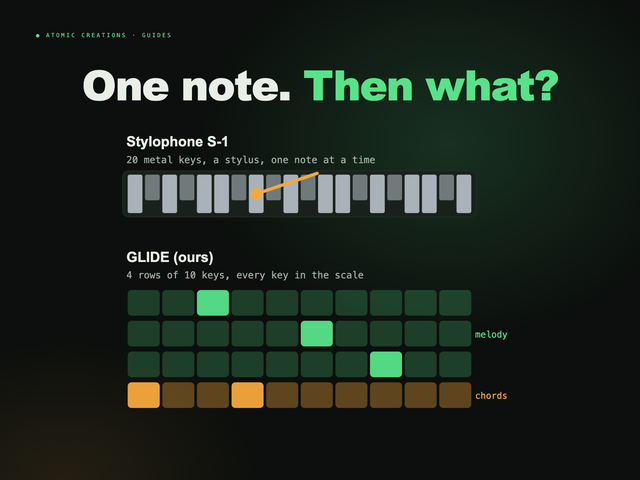
The hardest part for most people is Step 4: finding a melody that fits. GLIDE, the pocket synth we make, is built for that moment. Its bottom row loops a chord progression for you, and scale lock means every key you press for the melody fits those chords, so you can hunt for a tune without hitting a wrong note. A one-button looper catches the idea the moment you find it. Try the browser version below: tap a few chords on the bottom row, then play over them until something sticks.
Useful? Pass it on
← Browse all guides