A few chord progressions are behind a startling share of popular music. Learn six of them and you can play along with thousands of songs, and you will have a ready-made starting point for writing your own. Here they are, with charts in every common key.
The short answer
The most common progression in modern pop is I-V-vi-IV: in C major, C G Am F. Close behind are I-IV-V (C F G) for rock, blues and country, vi-IV-I-V (Am F C G) for a moodier feel, and ii-V-I (Dm G C) for jazz. The Roman numerals mean you can move any of them to any key.
- How to read Roman numerals
- 1. I-V-vi-IV: the pop progression
- 2. I-IV-V: the three-chord song
- 3. vi-IV-I-V: the emotional one
- 4. I-vi-IV-V: the 50s progression
- 5. ii-V-I: the jazz cadence
- 6. i-VII-VI-V: the Andalusian cadence
- Bonus: the 12-bar blues
- Chart: the pop progression in every common key
How to read Roman numerals
Musicians write progressions as Roman numerals so they work in any key. Each numeral is a note of the major scale, with a chord built on it. Uppercase means a major chord; lowercase means minor.
| Key | I | ii | iii | IV | V | vi |
|---|---|---|---|---|---|---|
| C major | C | Dm | Em | F | G | Am |
| G major | G | Am | Bm | C | D | Em |
So "I-IV-V in G" is G, C, D. The full set of chords for every key is in our circle of fifths guide.
1. I-V-vi-IV: the pop progression
If you only learn one, learn this. It is the backbone of songs like "Let It Be" by The Beatles (C G Am F) and "Don't Stop Believin'" by Journey (in E: E B C♯m A). It feels hopeful and complete, and loops forever without getting stale, which is why so many choruses use it.
2. I-IV-V: the three-chord song
In C: C F G. The foundation of early rock and roll, blues, folk and country. It is the strongest possible pull back home: the V chord practically begs to return to I. Countless first songs on guitar use exactly these three chords, often in G (G C D) or E (E A B).
3. vi-IV-I-V: the emotional one
In C: Am F C G. The same four chords as the pop progression, just started from the minor chord. That one change makes it feel bittersweet and yearning rather than bright. Starting a verse on the vi and a chorus on the I is a classic way to lift a song without changing chords at all.
4. I-vi-IV-V: the 50s progression
In C: C Am F G. Also called the doo-wop progression. It powers a whole era of ballads, including "Stand By Me" by Ben E. King (in A: A F♯m D E). Slow it down and it is instantly nostalgic.
5. ii-V-I: the jazz cadence
In C: Dm G C, usually played as seventh chords (Dm7 G7 Cmaj7). It walks counterclockwise around the circle of fifths, the strongest direction in harmony, so it sounds like arriving home. Jazz standards are built from chains of it, and it turns up in pop and soul as a smooth way into a chorus.
6. i-VII-VI-V: the Andalusian cadence
In A minor: Am G F E. A descending line with a dramatic, Spanish flavor, heard in flamenco and in songs like "Hit the Road Jack" by Ray Charles. The last chord is E major, not E minor, which gives it that extra tension before it loops back to Am.
Bonus: the 12-bar blues
Twelve bars, three chords, one of the most influential forms in music. In A (A, D and E, often played as seventh chords):
| Bars | Chords (one per bar) | |||
|---|---|---|---|---|
| 1 to 4 | A | A | A | A |
| 5 to 8 | D | D | A | A |
| 9 to 12 | E | D | A | E |
That last E is the turnaround that sends you back to the top. Solo over it with the A minor pentatonic or blues scale.
Chart: the pop progression in every common key
| Key | I | V | vi | IV |
|---|---|---|---|---|
| C | C | G | Am | F |
| G | G | D | Em | C |
| D | D | A | Bm | G |
| A | A | E | F♯m | D |
| E | E | B | C♯m | A |
| F | F | C | Dm | B♭ |
| B♭ | B♭ | F | Gm | E♭ |
Reorder the columns to get the other progressions: vi-IV-I-V is the third, fourth, first and second columns.
Loop a progression, then play over it
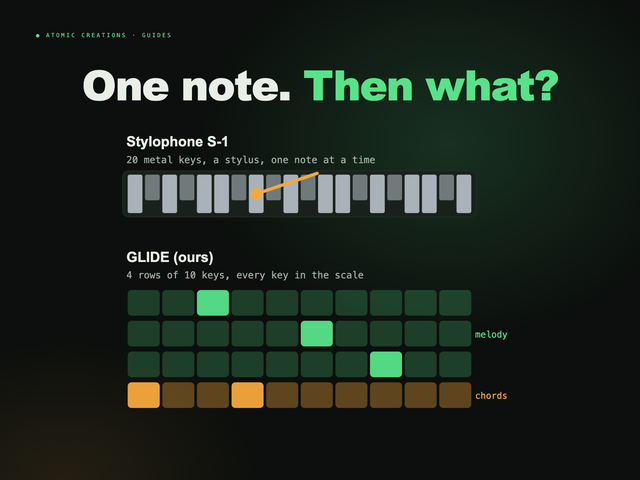
On GLIDE, the pocket synth we make, the bottom row of keys plays the chords of the current key. Turn on the progression mode, tap chords in order (four taps for I-V-vi-IV) and it loops them for you, one chord per bar, while you play a melody over the top on the rows above. Scale lock keeps every note in key. Try the chord row below: tap C, G, Am and F, then play over them.
Useful? Pass it on
← Browse all guides