Synthwave is the sound of a 1980s that never quite existed: a night drive under a purple sky, a chrome sports car, a city skyline glowing on the horizon. It is a modern genre built from the synthesizers, drum sounds and film scores of that decade, and it has quietly found its way into film, TV, games and the biggest pop song of the streaming era. Here is what it is, where it came from, how to tell it apart from vaporwave, and how to make it yourself.
The short answer
Synthwave is electronic music, mostly from the late 2000s on, that recreates the sound of 1980s film scores, video games and synth-pop. Think analog-style synths, rolling arpeggios, big gated-reverb drums and moody minor-key chords. It grew out of the French electro scene (Kavinsky, College) and broke through with the Drive soundtrack in 2011. Unlike vaporwave, which chops up and slows down old samples with a wink, synthwave writes new music that plays the 80s straight.
- What is synthwave music?
- Where synthwave came from
- Synthwave meaning: retrowave, outrun and friends
- What makes the synthwave sound
- Synthwave artists and subgenres
- Synthwave vs vaporwave
- The synthwave aesthetic
- How to make synthwave
- Full disclosure: this one is ours
What is synthwave music?
Synthwave is a style of electronic music that takes the sounds of the 1980s (analog synthesizers, drum machines, action and horror movie scores, arcade games) and uses them to write new songs. It is usually instrumental, though a growing branch has vocals, and it leans hard into mood: night, speed, neon, a little melancholy.
The key word is homage. Synthwave artists are not sampling old records; they are writing fresh music as if it came out of a 1984 movie soundtrack, often using modern software that imitates the synths of the time. The result feels nostalgic even to people who were not alive in the 80s, which is a big part of its appeal.
Where synthwave came from
Synthwave has two sets of roots: the 1970s and 80s composers whose synth scores it imitates, and the French electro scene of the mid 2000s that turned that sound into a genre.
- The film scores. Composers like John Carpenter (who scored his own films, starting with Halloween in 1978), Vangelis (Blade Runner, 1982) and Tangerine Dream built moody, synth-driven soundtracks that synthwave still borrows from today.
- The games. Sega's 1986 arcade racer Out Run, with its sunset highways and selectable in-car soundtrack, gave one strand of the genre its name.
- The French electro scene. In the mid 2000s, producers like Kavinsky and David Grellier (who records as College and founded the Valerie collective) started making electro that sounded like lost 80s movie music. Kavinsky's early EP Teddy Boy came out in 2005, and his whole act was built around a character who crashed his Ferrari Testarossa in 1986 and came back as a zombie making electronic music.
Then came the breakthrough. Nicolas Winding Refn's film Drive (2011) opened with Kavinsky's "Nightcall" (released in 2010) and used College and Electric Youth's "A Real Hero" (also 2010) as its main theme, alongside an 80s-flavored score by Cliff Martinez. The soundtrack reached number one on Billboard's soundtrack chart, and a whole generation of listeners went looking for more music that sounded like it.
| Year | Milestone |
|---|---|
| 1978 | John Carpenter scores his own Halloween |
| 1982 | Vangelis scores Blade Runner |
| 1986 | Sega releases the arcade game Out Run |
| 2005 | Kavinsky's EP Teddy Boy |
| 2010 | "Nightcall" by Kavinsky; "A Real Hero" by College and Electric Youth |
| 2011 | Drive and its soundtrack; the NewRetroWave site launches |
| 2012 | Hotline Miami brings Perturbator's music to gamers |
| 2016 | Stranger Things premieres with its synth theme |
| 2019 | The Weeknd releases "Blinding Lights" |
Streaming and YouTube did the rest. Labels and channels like NewRetroWave, which started as a website in November 2011, gave the scene a home. In 2016, Netflix's Stranger Things arrived with a pulsing synth theme by Kyle Dixon and Michael Stein, two members of the Austin synth band S U R V I V E; it won them the 2017 Emmy for Outstanding Original Main Title Theme Music. Bandcamp Daily's listening guide for Stranger Things fans is a good map of the darker end of that world. And in late 2019, The Weeknd's "Blinding Lights", widely described as synthwave-influenced synth-pop, went on to top Billboard's ranking of the biggest Hot 100 songs of all time.
The scene lost one of its founders this year: Kavinsky died in July 2026, at 50. "Nightcall" remains the track most people picture when they hear the word synthwave.
Synthwave meaning: retrowave, outrun and friends
The genre has several names, and fans use them loosely:
- Synthwave is the umbrella term, and the one most people search for.
- Retrowave is often used as a straight synonym, especially for the visual style.
- Outrun usually means the driving, sunset-and-sports-car strand, named after the Sega game. Kavinsky even called his 2013 album OutRun.
- Darksynth is the heavier, horror-flavored branch (more on it below).
So "synthwave vs retrowave" is mostly a naming question, not a musical one. If you like one, you will like the other.
What makes the synthwave sound
Most synthwave tracks are built from the same handful of ingredients. Learn to hear them and you can spot the genre in two seconds.
- Analog-style polysynths. Warm, wide pads and brassy leads, in the style of classic 80s instruments such as the Roland Jupiter-8, Sequential Prophet-5 and Oberheim polysynths. Today most producers use software versions.
- Arpeggios. A chord played one note at a time in a fast, repeating pattern. The Stranger Things theme is built on one, played by hand on an Oberheim, according to Roland's breakdown of how the theme was made (about 25 synths ended up on the final track).
- Gated reverb drums. A huge snare with a burst of reverb that cuts off abruptly: the signature drum sound of 1980s pop.
- Sidechain pumping. The pads and bass duck in volume every time the kick hits, then swell back, so the whole track breathes with the beat.
- Driving bass. Often a steady run of eighth notes on the root of each chord, jumping between octaves.
- Mid tempos. Much synthwave sits somewhere around 80 to 120 BPM; the darker, heavier styles often run faster.
Keys and chords. Synthwave often lives in minor keys, which give it that bittersweet, after-midnight feel. The progression above, Am F C G (i-VI-III-VII in A minor), is a favorite. It uses exactly the same chords as the pop progression vi-IV-I-V in C major, just heard from the minor side; our guide to relative minor and major keys explains why that works. For more loops to try, see the most common chord progressions.
Synthwave artists and subgenres
Genre lines are fuzzy and most artists cross between them, but these are the main branches you will run into, with a well-known artist and a good starting record for each.
| Subgenre | What it sounds like | Start with |
|---|---|---|
| Outrun | Driving, sunny-at-midnight, built for the highway | Kavinsky, OutRun (2013) |
| Darksynth | Aggressive, horror and cyberpunk flavored, often with a metal edge | Perturbator, Dangerous Days (2014); Carpenter Brut, Trilogy (2015) |
| Dreamwave | Softer, slower, melancholic and romantic | Timecop1983, Night Drive (2018) |
| Vocal synthwave and synth-pop revival | Full songs with singers, choruses and sometimes saxophone | The Midnight, Endless Summer (2016); FM-84, Atlas (2016); Gunship, Gunship (2015) |
| Chillwave (a close cousin) | Hazy, lo-fi indie pop with reverb-soaked vocals, from around 2009 | Washed Out, Toro y Moi, Neon Indian |
A few notes on the names. Perturbator (James Kent) and Carpenter Brut (Franck Hueso) are both French, and both came to synthwave from the metal world; Metal Hammer's feature on darksynth tells that story. Perturbator's music reached a lot of gamers through Hotline Miami (2012) and its sequel. The Midnight are singer Tyler Lyle and producer Tim McEwan, formed in Los Angeles in 2012. FM-84 is Scottish producer Col Bennett, and Atlas features singer Ollie Wride. Gunship are a British band formed in 2014. Timecop1983 is Dutch producer Jordy Leenaerts.
Synthwave vs vaporwave
They get confused constantly because both are internet-era genres obsessed with the past and both love a pink-and-teal gradient. But they are opposites in spirit.
| Synthwave | Vaporwave | |
|---|---|---|
| How it is made | New, original music played on synths | Samples of old music, slowed down, looped and drenched in echo |
| Source era | 1980s film scores, games, synth-pop | 1980s and 90s smooth jazz, elevator music, R&B, commercials |
| Attitude | Sincere homage | Ironic, dreamy, often read as a comment on consumer culture |
| Tempo and feel | Mid tempo, driving, dramatic | Slow, woozy, hypnotic |
| Visuals | Neon grids, sunsets, sports cars, chrome | Greek statues, early web graphics, old operating systems, Japanese text |
| Landmark releases | Kavinsky, "Nightcall" (2010); the Drive soundtrack (2011) | Chuck Person's Eccojams Vol. 1 (2010); Macintosh Plus, Floral Shoppe (2011) |
A quick test: if it sounds like a movie chase scene, it is synthwave. If it sounds like a mall at 3 a.m. on half speed, it is vaporwave.
The synthwave aesthetic
Synthwave is as much a look as a sound, and the look is instantly recognizable: a glowing perspective grid running to the horizon, a huge sun sliced by horizontal stripes, palm trees and mountains in silhouette, chrome lettering, VHS scan lines, and a sky fading from violet to hot pink. Most of it traces back to 80s album covers, movie posters and arcade cabinets.
The trick is the same as in any neon look: lots of darkness, two or three glowing colors, and nothing in between. If you want to bring it into a real room, our guide to cyberpunk room decor covers lighting and palettes that work just as well for a synthwave setup.
How to make synthwave
You do not need vintage gear. A laptop and free software will get you a convincing track. The drum side works like any other beat, so if you are brand new, start with how to make a beat. Here is the synthwave recipe on top of that:
- Pick your tools. A free DAW like BandLab (browser) or GarageBand (Mac and iPhone) works. For sounds, Vital has a free tier and does lush pads and leads, and Dexed is a free emulation of the Yamaha DX7, the source of countless 80s electric pianos and bells.
- Set the tempo. Try 100 to 110 BPM for a classic night-drive feel, or slower for dreamwave.
- Write four minor-key chords. Am F C G is a safe start. Use a warm, slow-attack pad and let each chord last a full bar.
- Add the arpeggio. Break each chord into root, third, fifth and octave, played as sixteenth notes (most DAWs have an arpeggiator that does it for you). Keep it bright and a little quieter than the pad.
- Lay down the bass. Eighth notes on each chord's root, bouncing between low and high octave. Simple and relentless.
- Program big drums. Kick on every beat or on 1 and 3, a snare on 2 and 4 with a gated reverb (a reverb followed by a noise gate that chops its tail), and steady hi-hats.
- Sidechain it. Put a compressor on the pad and bass, triggered by the kick, so they duck and swell on every beat.
- Top it with a lead. A simple, singable melody, ideally one you could whistle after one listen. A little glide between notes and a dotted-eighth delay make it instantly 80s.
- Wash it in space. Chorus on the pads, a long reverb on the lead, and a touch of tape-style wobble if you have it.
Stuck on the melody or lyrics? The songwriting side is the same in every genre. Our guide on how to write a song walks through hooks, structure and finishing.
Full disclosure: this one is ours
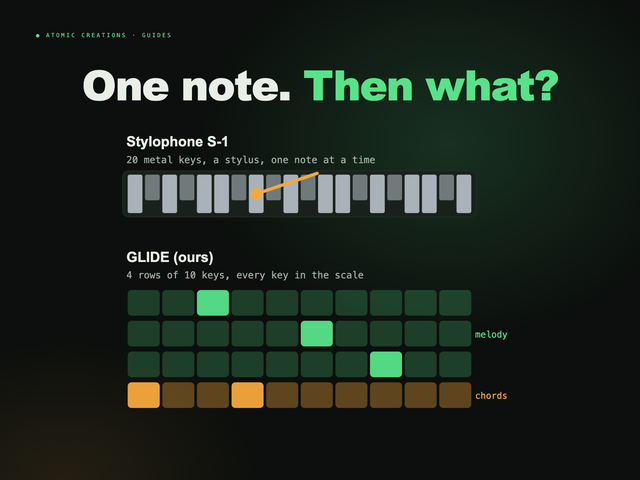
A lot of the synthwave toolkit, as it happens, is built into the pocket synth we make. GLIDE ($119.99) runs on the M5Stack Cardputer ADV and turns its keyboard into four rows that play like strings, so notes slide into each other the way a synthwave lead should. Tap four chords on the bottom row and it loops them as a progression, one chord per bar; turn on its arpeggiator and those chords roll up and down on their own while you play a lead on the rows above. Switch the scale to natural minor and the chords come out in that bittersweet key.
For the sound itself there is chorus, a reverb and a delay that locks to the tempo (including that dotted eighth), two LFOs, a second envelope, four filter modes, and a gentle analog-style drift that keeps held chords shimmering. Every unit also rolls its own generated sounds that no other device has. And if a synthwave track is playing in the room, hold fn+K and Auto Key listens through the mic, retunes GLIDE to the song's key and syncs the delay to its tempo, so you can jam along straight away. It does not make drums, so it is a sketchpad for the chords, arps and leads rather than a whole studio.
You can play it right below, in your browser.
Useful? Pass it on
← Browse all guides